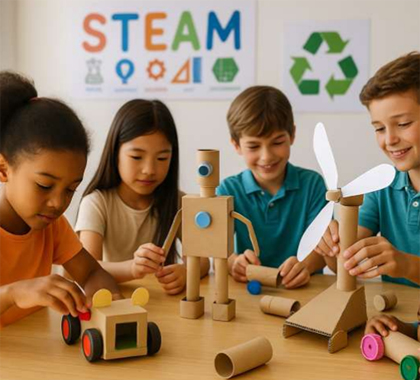
To work with educators and their 3-18 year old students interested in STEAM projects. This group represents children who are eager to engage in adventurous and creative pursuits, with a thirst for exploration and discovery. They thrive in environments that encourage curiosity, creativity, and active participation.
We want to highlight Sustainable STEAM in remote locations. By building and designing wind/solar-powered vehicles, survival shelters, gear/clothing and research centres in remote places, students can impact anything and everything that might enable sustainable STEAM activities.
The principles we are embedding are: sustainability, renewable energy, lightweight/small-footprint scientific/STEAM expeditions, physics (wind, motion and friction) and engineering etc. This ties-in with our attempt at a sustainable STEAM Arctic expedition.
We want students to dream BIG and deliver their thoughts and ideas.

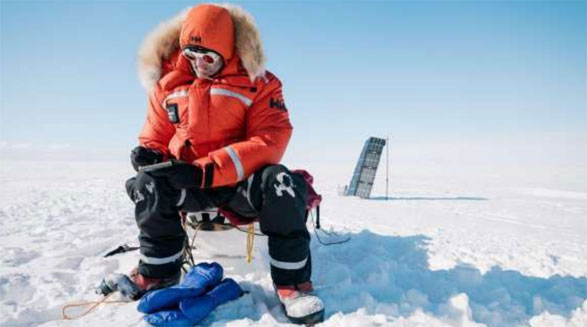
Ice thickness, subsurface layering & potentially snow density. We will also accurately measure surface elevation using a GNSS receiver. Most of this data is now obtained routinely via satellite, but particularly as we’re travelling in rarely travelled areas, the data that we get can be used to ground-truth/validate satellite data, to confirm that they are providing correct information.
Any data that we collect will be stored in an open-access database to enable scientists globally to use this information to compare with their own data and to validate satellite information.
We will also measure meteorological data en route, record our own physiological data, and record Snowsailer accelerations in 3D.
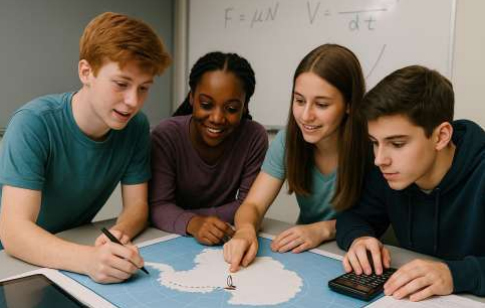
By integrating this with simple math challenges (distance between two points, speed calculations, etc.) they can project how long we’ll take; even doing simple physics equations re. friction of the ice/snow and our velocity etc.